
Showing posts with label Tips. Show all posts
Showing posts with label Tips. Show all posts
1.16.2010
Events: DC Coasts Annual Guys Cooking Class
Want to surprise your lovely lady with those culinary skills that she (and perhaps you) didn't even know that you had? Sign up for DC Coasts annual cooking class for guys, which takes place about a week before V-Day, so you have a chance to see the chef in action and learn some new moves!


9.11.2006
Wine & Food Pairing: Wine Vocabulary and Buzz Words
If you have every been to one of my cooking classes, you know that I put together a little packet that includes some'kitchen vocabulary', words that line cooks and chefs use in the kitchen, as well as some more 'definition' oriented cooking terms, techniques, etc. that are directly related to the class.
Well, for this Easy Pasta Dinners Williams-Sonoma Cooking Class series, I am also going to comment in class on how to do food and wine pairings. I won't be recommending bottles, prices, regions, etc. It'll be more helpful, a set of beginners rules on how to match food to wine, to find complementary and interesting combinations. It will allow you the knowledge to start matching, tasting and picking your own regional, $$$ limits and styles. Isn't that what learning in a 'class' is all about?
So just to share, for the classes I also put together a wine and food pairing packet that includes some 'wine vocabulary'. Just some basic definitions or buzz words that will help you feel confident the next time you walk into that wine shop and are challenged by the wine retailer.
Wine & Food Pairing Vocabulary & Buzza Words
acid
Used as an adjective to describe sharp, tart or sour flavors. A cool area (Germany) produces wines high in acidity and a warm area produces wines that are low in acidity (California).
age
Wine is a food item that gets better with age. Each type of grape has a different science to aging it in order to produce the most complex wine possible. Some everyday wines don’t need any aging and can be drunk right away, other wines, such as port, can age for decades before it comes to its drinking age.
balance
The trilogy of basic wine tasting, smelling or describing: tannin, fruit and acid.
barrel fermentation
When the grape juice is fermented in oak barrels to add more complex, buttery, oak flavor to the wine.
body
Tasting term to describe a style of wine, full bodied or light bodied. Full bodied has a weight in the mouth, tastes of alcohol and lots of extract or extract flavor and light bodied wines are completely the opposite.
bouquet
The smell of wine, referring to all the complexities.
breathe
When wine is exposed in the bottle or while decanted to air for a period of time before drinking; allowing it to express its complexities more fully.
buttery
Usually referring to barrel-fermented wine describing the rich, creamy characteristic flavor of the wine.
cult wines
A wine that is very trendy, very scare and therefore usually very expensive.
decanting
When wine is poured out of its stored container into another container to breathe before serving and help remove sediments in the wine.
extract
Usually referring to red wines that have a thickness to them that coats your mouth. The wines can also be highly extracted or over extracted that exponentially describes their thick factor.
fermentation
The process where all the yeast eats up sugar in the grape juice extracted from the grapes and excretes alcohol, turning grape juice into wine. See YEAST.
fortified
A wine that has spirits added to it, like port or sherry.
fruity
The fruit smell or flavor in wine.
glass type
The type of glass that the wine is served in says a lot about the wine that is being served. The material it is made of, the stem length, the bowl shape, size, range, where you grab the glass and if it is hand washed or machine washed.
late harvest
A wine that was made with grapes that were harvested much later then normal, usually producing a much sweeter wine because the grapes where in the sun much, much longer.
New World
When a wine is produced in the new world. Basically, a non-European area.
nose
Another term for the bouquet or smell of the wine; What is notable used to smell wine.
nutty
A term usually referring to whites, which expel a flavor or nuts.
oaky
The word referring to the level of oak in the wine. See BARREL FERMENTATION.
Old World
When a wine is produced in the old world. Basically, most European regions.
oxidized
When a wine is overexposed to oxygen (perhaps not stored well – too hot in the cellar, broken cork, etc.), which eventually turns the alcohol to vinegar.
parkerization
Robert J. Parker is the utmost respected and end-all critic of wine and therefore people refer to his descriptions, ratings, etc. almost as a separate part of rating, describing or referring to a wine. Read about his contributions, best selling books and uber-world famous wine rating system that literally affects the world wine market at http://en.wikipedia.org/wiki/Robert_M._Parker,_Jr.
residual sugar
The amount of sugar leftover after fermentation.
show wine
A term that describes the critics positive response to the wine.
structure
A tasting term that refers to the tannins and acidity of the wine.
tannin
The bitter skin of the grapes and can be used as an adjective that refers to that bitter, tooth-coating, dry sensation you get in red wine. It is a vital component in referring to red wine.
yeast
A living organism used in the production of bread and beer. Yeast, in the environment of sugar, produces carbon dioxide and alcohol. This process is called fermentation.
11.30.2005
Article: So You Want to be a Personal Chef?
My personal advice to those considering a personal chef business:
1. Get certified. Get Educated.
If you want to be taken seriously by not only your customers, but your peers – get certified and educated.
Part I: A (personal service or catering) business license, appropriate (catering or personal chef) insurance, your local food safety management certification through the National Restaurant Association Educational Foundation and then of course, following the regulations and local city or county laws.
Educate yourself on local liquor laws, food transportation issues, etc. I would never hire or take seriously a caterer/personal chef that doesn’t carry insurance or tells me how they deliver their meals out of a cooler in their Pathfinders trunk. True stories!
Part II: If you don’t have a culinary degree or business experience, get some through your local community collegue, culinary school, culinary class outlet, local foodie clubs, associations and non-profits.
Listening to others experiences, gaining basic knowledge about accounting, business management or even cooking techniques. These gain you experience ‘in the field’ without even doing an actual ‘cook date’. They also help you build collegue references and give you an opportunity to ask all the questions you need answered about the ‘logistics’ of being the food business.
I will also insert into this section that it is probably important to join a personal chef association only if you have no idea how a daily personal chef business works. Most personal chef associations make you pay a horrible fee to be a member that allows you to get introductory information about the business and a listing on their website list of members. You need to decide for yourself if having an outline of what a day in the life of a personal chef is like is worth $500-$1500 for the first year and $150-$350 per year after that.
2. Figuring out ‘What you do’.
A good way to figure out what kind of cooking/service/product you want to provide is to first analyze your experience and then cross check that with what kind of client you want to cook for/service.
Middle-class, both parents work, with 2 or more kids? Fad dietiers? Young Professionals who want to eat in 2 minutes? Uber-rich busy people who don’t want a live-in private chef?
Everyone will say – of course – uber-rich people that will over pay me and I’ll be set for life! Be serious…99% of personal chefs across the nation serve the standard middle class, family of 4 with a bunch of freezer ready casseroles. I know one personal chef that makes 4 servings of 5 casseroles for $395, including groceries. Can you say – 90% profit!
This will help figure out not only your ‘service niche’, but your pricing, your demographics and that will lead to where you need to market – be it a local school board letter or just through your website.
3. Don’t quit your day job.
Sometimes it takes a while to build a client base, get your marketing going and just being ‘open for business’ with your website live and your phone on, just isn’t enough. For every person starting a new business there is a new path on how it happened or how it become to be a ‘full-time’ job.
One personal chef I know just starting cooking for a neighbor while they were recovering from chemo, the neighbor suggested they do this for a ‘job’ and through the clients referrals and the chemo-outpatient nurse, in 3 months they had a full time personal chef meal delivery service, niched for cancer treatment patients in out-patient. Another chef I know, after a year, never got more then 1 steady personal chef client. They tried to make ends meet by teaching cooking classes and barely a year after that they have flipped their business where 90% of it is teaching cooking classes and they will fill in a personal chef client when they have the time.
4. What are you willing to do to be famous?
It sounds like what a seedy holleywood studio manger would say to a young and beautiful, wanna-be starlet. Sadly, it is very translatable to the success of your personal business. And nothing is a guauntee.
Are you willing to work for next to nothing just to get your business name out there? Are you willing to negotiate your prices to keep that client? Are you willing to give discounts, donations to charities, etc.?
Some personal chefs I know are unwilling to do any of the above. Frankly, all of them are successful personal chefs that have been in the business for almost 10 years, as long as it has been around. I don’t truly think they understand what it takes to start a personal chef business today, now that there are over 300 personal chefs in my DC Metro area alone! You have to be competitive and sometimes, ‘discount’ yourself out.
When I started my personal chef business, I under priced everyone, trying to get any clients, even if they were cheap – and it was hard work. But I knew I had the focus and a product that would make this business successful. Therefore, as my business grew, so did my prices. In just a few years of service, I am making 3 times the amount I made when I started my business. And comparing myself others, my prices sit in the median-lower rang, so I still have room to grow – in fact, I can raise my prices at least 40% before I am in direct competition with some other expensive personal chefs in my area.
This is all up to you and how bad and hard you want to work to get your business started.
5. Marketing, marketing, marketing….marketing!
If you have ten clients a week or zero clients a week. Marketing needs to be a weekly shot into your business.
6. Do the basics:
Get a separate phone for your business. There is nothing worse then calling what you think is a business and there is some 3 year old on the answering machine saying ‘The Andy-sons ain’t home white now!” Would you leave a message? Then why would your customer. And with cheap cell phones, you can carry your business line with you all the time, ready to get that next client!
Get a website Be a million dollar site or a build it your self site for $10 with just your name, phone and email. I get 99% of my new business from my website and people always say “You have the best website” – “Your food on your website looked so good, I had to call you” – “Your menus are exactly what we want for our party”. The more information you provide on your website to your ‘niche’ (pictures, menus, faq’s) customer, the more you will weed out those that you don’t want to serve. My personal website advice – Don’t put your picture on your website unless your hot. Many a marketing researcher knows, people subconsciencly do not relate to unattractive people. And frankly, just keep your picture off your website altogether - whether you are hot or not – it is probably NOT a good idea. You might be putting yourself in danger, since you work mostly by yourself, in a strangers home - a pervert might figure this is a good way to get you alone in the ‘comfort of their home’.
Get an email account: Some people looking for caterers/personal chef will email you when they have time, meaning, it may be 2am after they have spent time with their significant other, after putting the kids to bed, after making dinner for family, after working until 8pm….come up with ‘auto-responses’ describing the basics of your business and some things that ‘hook’ a client into your niche. And for petes sake, please don’t use a personal account – like ‘MrsRobinson@aol.com or Drinkmorethanyou@hotmail.com’ – then you are advertising more than you would probably like to a potential customer.
Online listings: Get on any and all local and national website, email and business listings you can. Your goal…When someone googles your business name – you are the first listing that shows up. You want people to be bombarded with your business – because when you see a business advertised everywhere – don’t you think they must be a respected, well-known business…
11.28.2005
Tip: De-Seed a Pomegranate
Pomegrantes are the new 'haute' of cuisine, especially now that they are in season. You can easily drop $3 bucks on one of those snowman shapped juices and $8 bucks on the nuevo pomegranate molasses.
But can you get out those pretty little seeds without making a mess or loosing half the seeds to the juice on your cutting board gods?
Scaning over some pomegranate salad recipes for a client, I was horrified to learn that Nigella recommended cutting into your pomegranate with a knife, and just remove the seeds that weren't broken!?! That would be like cutting into an orange and then trying to remove the segments, without spilling any juice or wasting any segment?!? I started googling around found that most recommended this (even the site: http://www.pomegranate.org/nomess.html which I thought was a little funny).
Therefore I thought I would make the apparent top secret way to de-seed a pomegranate known.
I learned this trick from a persian chef who has probably been cooking with real pomegranates longer then I have known what a pomegranate even was.
- First, using a sharp pairing knife, you want to cut a 'curly cue'. Like you are cutting away the peel and pith from an orange without getting the segments of juice - but all in one long curly cue line. from the top of the pomegranate to the bottom. You are only cutting in about an 1/8th inch, just through the pith, with the intention of not cutting into any seeds. Take your time, this is the most imporant part of the process and will decide if the rest of the process is 'juice free and easy' for you.

- Carefully working around the pomegranate, loosen the cut you made, pulling the cut open about a 1/4 inch or so.

- Now you can pull the pomegranate apart easily, into sections.

- Take a section and hold it in one hand, you can run your thumb along the seeds, bending them back and forward gently to have them 'pop off' the pith.

- If you run into a section that is covered with a lining of pith, just peel it away before popping off the seeds from that section.


Other tips:
- You want to remove all the pith, even the little dots of it that stick to some of the seeds. It tastes like eating orange pith.
- You don't need to wear gloves - you aren't going to make a mess right? And if you get a little juice on you, just wash your hands off and then return to pomegranate peeling bliss.
11.21.2005
Advice
A lot of people email me for recipes, jobs and even advice on how to be a chef or start their own Personal Chef business. So in the next few posts, I have put together some ideas on the matter.
8.20.2005
Tip: Extending your Cheese Knowledge
Some people are wine buffs - I would be a cheese buff. I can't get enough of the stuff, be it blue, bloomy, brown or basically all butter fat, I am a fan of them all.
A cheese course is pretty standard with most of my dinner parties. When choosing cheeses, people often want to stay with what they know, some cheddars, perhaps a herb crusted goat cheese or maybe out on a limb with a brie. There are so many cheeses out there that people don't fully take advantage of.
With my weekly clients, I try to 'fold in' a new cheese into their daily meals - like substituting an american blue with a castelmagno (Origin: Piedmont Italy; mix of cow and sheep or goat, but mostly cow's milk; mild, slightly tart and intensely nutty) or instead of the typical soft ash goat cheese, try the garrotxa (Origin: Catalonia, Spain; goat's milk, semi soft, natural rind; creamy, herby-probably from the herbs the goats ate-nutty and slightly acidic -just like goat cheese- in flavor). I've listed a recipe for each below that you may want to try.
So next time you are wandering into Whole Foods Clareton/Arlington or Balducci's Alexandria Old Town (these two locations are my favorites for cheese selection in Northern Virginia area)find your favorite cheddar, then look around at its "family" for cheeses with similar descriptions, you are sure to find something new that you really like and can add to your repertoire. At these two grocery store locations, the cheese staff is very helpful and generally more knowledgeable than most other grocery store locations (even wine/cheese shops) that I visit.
But if they aren't answering the questions you are asking - ask to see their Cheese for Dummies book. Both locations have one - and in a matter of seconds they can hand you the book to browse over for your favorite cheeses and its family members. Balducci's Old Town will even special order cheese for you at no additional charge. It'll take about a week, but they'll even call you when the cheese arrives, so you get the first nub off it!
8.13.2005
Q&A
I thought I would answer a few questions/comments I have received from readers....
Q: What is a Personal Chef?
A: Personal Chef: (definition) Similar to a private chef, but instead of cooking solely for 1 family as staff, on a salary, they cook for numerous clients on a part-time basis, usually compensated on a per meal basis.
Q: What kind of personal chef are you?
A: I am a personal chef, I cook for up to 3 clients/day, in their homes, personalizing, preparing and packaging their daily meals for their to heat at their leisure. I shop for their meals, right before I head to their house to prepare them. My favorite and most visited grocery stores are Balducci's, Whole Foods Market and Mom's: My Organic Market. I prepare only 'fresh meals', meaning nothing I make is intended to be frozen - clients usually enjoy the meal sometime in the next few days after I have prepared them. I provide fine-dining meal services, meaning that the types of dishes I prepare for my clients are (equal to or better than) the majority of 'fine dining classified' establishments in the DC metro area. I like to let people know that if you are looking for frozen casseroles, my personal chef service is not the service for you. Sometimes for clients or special occasions, I will do private cooking classes, seated formal course dinners and pro-bono work.
Q (kinda): I need recipes that I can prep a day or so ahead of eating them.
A: Unless I say otherwise (meaning I cook it for myself or it is a picture/description of a restauant dish) all the pictures, recipes and cooking comments are from my daily personal chef escapades - meaning dishes that are prepared ahead of time - for my clients to heat and enjoy up to 4 days after I prepare it. Some weeks I can make up to 80 dishes (not including sauces, salads, sides, etc.) and so what I post is a small portion of what I am doing. If there is a specific question about how a particular dish can be prepped ahead of time - I'd be happy to help out at shanna/at/finediningsolutions.com.
8.12.2005
Summer Braising?

Okay, braising is technically 'out of season', but don't you still love it?
I ordered braised veal cheeks at Vidalia last week and they were wonderful! Does this mean that I am wrong? I don't believe so. There are several ways to enjoy a great braised dish and just 'mixing up' the traditional braising ingredients (mirepoix, herbs, liquid) can make any braising dish summer appropriate.
But first, lets make braising clear. When I meet with new clients - and chat with them about the cooking methods they would like me to employ in their dishes, as I go through a list...saute...broil..roast...braise...most people stop me and say "Whats the difference between braising and roasting? I think I like/hate them both?".
- Roasting: cooking food by surrounding it with dry, heated air. Roasting and baking are esstentially the same, but roasting usually referrs to meats and baking is usually applied to well, baking things, like cookies. Roasting takes place in an oven, be it convection or whatever and the food is literally 'dried out' in the cooking process.
- Braising: In a way, it is roasting a meat, but placing the item in a large, sided pot and covering the roasting item with (up to) a 1/3 of liquid. It is a combination of 'drying out' the food with roasting/baking and 'moistening' the food with a liquid. Braising can be done stovetop or in the oven.
- Stewing: Involves the braising technique, but mostly smaller meat pieces, be them tough (beef chuck) or tender (beef tenderloin), therefore a shorter cooking time. Although the pieces to be stewed may not always be seared or sauteed first, but can also be blanched (veal blanquette). And unlike braising, the meat is covered completely with liquid.
- Poeleing: Involves the braising technique, but usually refers to cuts of meat that are tender and not to fatty (tenderloins, duck breasts) not the usually braised items (short ribs, veal cheeks). The cooking process is a much quicker one, since these items are so tender, therefore limiting the amount of braising liquid and most likely using a 'true' cooks fat (bacon grease, duck fat, butter).
Orange Ginger Beef Short Ribs with Apricots
- 2 T. Butter
- Mirepoix (with about 50% carrots)
- B.G.
- 2 T. Butter
- 1 c. Seasoned Flour
- 4 Beef Short Ribs, extra fat trimmed
- 4 c. OJ
- 1 - 3-4 inch knob of ginger, peeled and diced
- 4 c. Veal Stock
- Muscat or other very sweet white wine
- Butter
- Apricots (1/4 c. julienned dried apricots/person or 1/2 fresh apricot poached in 3:1 simple syrup)
- In a pot large enough to hold the short ribs and cover them completely with liquid, saute mirepoix in butter until golden brown and remove.
- Dust short ribs in flour and saute, getting the outside as brown as possible without burning.
- Add mirepoix, B.G., OJ, bring to boil, simmer, cover pot with foil and reduce OJ by half. *Short ribs should be covered mostly with liquid. (20 min)
- Add knobs of ginger and 1/2 of beef stock, cover and continue to simmer. (30 minutes)
- Add remaining beef stock, cover and continue to simmer, until short ribs are tender and can easily be flaked away from bone. (up to 40 minutes)
- Remove short ribs and set aside. Run braising liquid through sieve to remove B.G., ginger, mirepoix. Then run braising liquid through chinois and return liquid to stove to reduce. You want to reduce the liquid down to sauce consistency (Chefs term) where the syrup is thick, like you would expect sauce to be.
- At the same time julienne dried apricots or poach fresh slices of apricot in simple syrup.
- Once braising liquid is thick, run sauce through chinois with cheesecloth in it. Emulsify (whisk in at low temperature until completely mixed) in 1/2 T. butter/person.
8.03.2005
Tip: No Mess Papaya

Ever been confronted with a large papaya in the grocery store and your first thought is "I wish I could buy it" followed by "Papayas sure make a mess" in the kitchen?
Here are some easy tips on to break it down (chef speak for cutting it up so that you can use it for cooking) a papaya without dropping a single papaya seed on your cutting board and getting all the yummy green or pink-orange goodness out of the fruit.

- Top and tail the papaya (chef speak for: slicing the top and bottom off, forming flat surface on each end - Pictured right).
- Stand the papaya on one of the flat ends.
- Hold one side of the papaya, using a boning knife or filet knife in the other hand, slice down from top to bottom alongside the papaya, trying to get only the skin off and without removing any pink (if ripened). Continue to circulate the papaya around, moving the papaya with your non-knife holding hand and continuing to remove all the skin with the other.
- Once all the skin is removed, change knifes and use a chefs knife or veggie knife. Slice down in the same motion as before, but this time, cut about a 1/4 inch into the pink. You'll be removing long strips of papaya, a few inches wide(Pictured Right).

- Once you have gone all the way around the papaya, start the process over again, going another 1/4 inch into the papaya. Be gentle, you are probably starting to feel that papaya in your non-knife holding hand is much lighter and if you push in the sides, it feels like it is hollow. Don't squeeze to hard though because it is full of seeds and one hole in the papaya can explunge dozens of seeds all over your cutting board.
- If you happen to slice into seeds, stop cutting. Start at the top again and move down along the papaya, perhaps only an 1/8 th inch in, keeping the seeds in the papaya and off your cutting board. Stop slicing once you have spun the papaya around 2-4 times and you can't cut off anything without cutting into seeds.


Now you can use the pieces you cut off (pictured right) to make brunoise (chef speak), juliennes (chef speak) or I guess just eat the whole long strip in one sitting....whatever floats your boat.

7.21.2005
Tip: Peeling Ginger
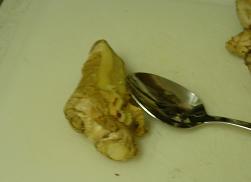
Like to use ginger in your food, but hate to try and peel it with a potato peeler? Or perhaps you slice off the sides and then end up using only about 40% of what you bought, because you cut off all the little knobs?
A little tip is to use a large serving spoon as a peeler. Just hold the ginger root the same way you would if you were going to peel it with a potato peeler and then turn the spoon upside-down and scrap against the ginger root, away from you, lightly and quickly, to easily remove the unwanted, bitter skin.
It will take you half the time it would take to use a peeler or knife and you get to use about 99% of the ginger that you bought!
Subscribe to:
Posts (Atom)